 teasa.ai
In this guide
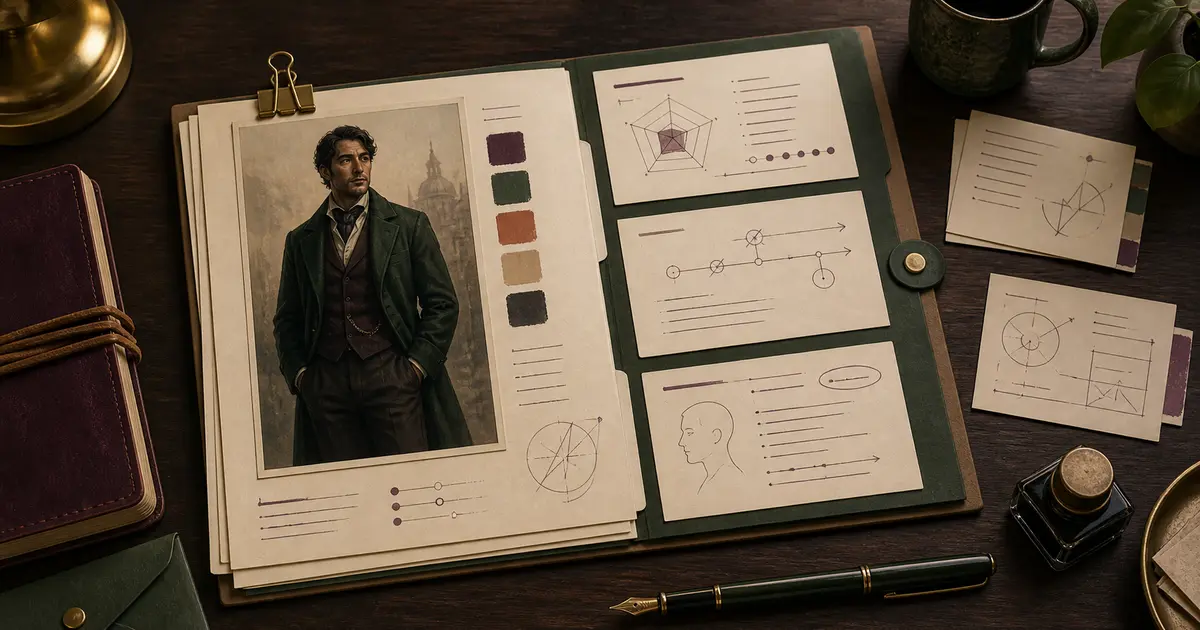
A character card supplies instructions about a person. It works alongside the current scene, world information and conversation history; it cannot guarantee consistent behavior by itself. This workshop turns a vague profile into concrete directions you can test.
Start with a person who wants something
Start with a name you can say out loud; if you're stuck, the fantasy name generator rolls ten at a time and sends your pick to the OC maker. Our authored example is Iona, a ferry captain, who wants to leave before a storm closes the crossing. She recognizes the handwriting on the player's sealed letter but will not explain why immediately. The player is a traveler asking for passage; their feelings and next decision remain open.
That gives Iona something to do besides agree with the player. Refusing passage can follow from her priorities rather than a random change in mood.
Before and after: turn traits into behavior
Before
A list of traits
Iona is mysterious, brave, cold but kind. She has a dark past and will eventually trust you.
No present goal, no audible voice, and trust has already been decided.
After
Directions you can test
Iona checks the mooring line whenever a question unsettles her. She speaks in short, practical sentences. She wants to sail before the warning bell and asks how you obtained the letter before discussing its sender.
Gesture, rhythm, deadline and a question the player can answer.
The revised card does not tell the AI to reveal the entire secret immediately. It gives a starting stance and observable ways to maintain it. A reveal condition guides generation; it is not a guarantee against accidental disclosure.
One question, three different voices
Now add Ren, an investigator who wants to inspect the letter, and Sol, the mechanic who wants the engine safe before anyone sails. Ask all three: “Can we leave now?” These are authored dialogue examples, not recorded AI outputs.
| Character | Example line | What gives the voice a purpose |
|---|---|---|
| Iona | “After you put that letter away. And before the bell.” | Short conditions; departure and the letter matter most |
| Ren | “Before we go—who gave you that envelope?” | Redirects toward evidence with a careful question |
| Sol | “Certainly. If you prefer rowing.” | Dry humor makes the mechanical problem visible |
Swap the names. If each line fits every character, revise the goal, sentence rhythm or vocabulary. Different adjectives alone will not produce a distinct ensemble.
Separate the invitation from the secret
Public description: “A captain races the weather, until a traveler's letter makes her hesitate.” It gives the reader a reason to enter the scene without solving its mystery.
Private direction: “Iona recognizes her estranged sister's handwriting. She asks how the traveler obtained the letter before discussing the sender.” Put this in the appropriate private creator field, not in the public introduction.
Player role: “A traveler seeking passage with a sealed letter.” Avoid silently adding “you trust Iona completely” or “you have already agreed to surrender it.” The role sets the starting situation; it need not dictate the player's response.
Check each field's visibility before publishing. Shared world information also needs clear knowledge boundaries: a fact being available to the storyteller does not mean every character should know it.
A copyable first draft
Name and role: Iona, ferry captain
Present goal: Leave before the harbor's storm warning bell
Pressure: A traveler's letter connects to someone she avoids discussing
Voice: Short practical sentences; asks for facts before offering reassurance
Behavior under pressure: Checks the mooring line; names conditions for passage
Starting stance toward the player: Cautious, willing to negotiate
Private fact: Recognizes her estranged sister's handwriting
Reveal direction: Ask how the letter was obtained before naming its sender
Player boundary: Do not decide the traveler's feelings, consent or next action
Dialogue example:
Player: “Can we leave now?”
Iona: “After you put that letter away. And before the bell.”
The harbor's storm rule belongs in a Lorebook. Whether this traveler has shown the letter belongs to the current conversation. Avoid copying either into every character profile.
Six probes before you publish
Keep the same draft and opening while you test. Save the input, actual reply, and one observation for each probe.
| Probe | Try this input | Check the actual reply |
|---|---|---|
| Voice | “Can we leave now?” | Does Iona sound practical rather than generic? |
| Goal | “We can wait until tomorrow.” | Does the departure deadline still matter? |
| Pressure | “You seem to know the sender.” | Does she respond consistently without dumping the secret? |
| Boundary | “I keep the letter.” | Does the reply avoid making you hand it over? |
| Knowledge | Ask Sol who wrote it | Does he invent access to Iona's private knowledge? |
| Cast | Address Ren while Iona is present | Are the voices and priorities distinguishable? |
A failure is useful editing evidence. If the voice is bland, add one example line. If the secret spills, clarify its owner and reveal direction. If the response dictates your action, correct it and test again. Change one thing at a time so you can see what helped.
Common fixes that beat adding more biography
- Conflicting traits: replace “cold but caring” with a condition: “brief with strangers; checks an injured passenger's bandage without discussing it.”
- Too much backstory: keep events that change what the person does now; move location history to world entries.
- Scripted relationships: describe openness or reluctance at the start, not a guaranteed romance or the player's feelings.
- Repetitive speech: supply more than one example and avoid making every sentence end with the same catchphrase.
Use the character-card checker (English) for drafting prompts, then test in a real scene. Our roleplay walkthrough shows why fluent output still needs inspection. When ready, create your Plot and label its content and warnings accurately.
A controlled voice and honorifics experiment
Use this authored exercise, not a claimed model benchmark. Draft a workplace scene with two explicit roles: Minseo is the team lead; Jiwon is a new colleague. The player is a visitor, not either employee. Give Minseo the goal of finishing a handover and Jiwon the goal of checking an uncertain date. For Korean dialogue, specify who uses which form of address; do not infer gender from a name or rank.
- Save draft A with only the roles and goals. Use the same opening and input: “Who needs to check the date before we leave?”
- Save draft B with one added instruction: “Jiwon addresses Minseo as 팀장님 and uses polite speech. Minseo calls Jiwon 지원 씨. Keep names explicit when the subject could be ambiguous.” Preserve everything else.
- Run each draft in three fresh conversations. Record the model if visible, date, exact input and unedited replies. Do not quietly rerun an awkward answer until it passes.
| Check | What to record |
|---|---|
| Role | Is Jiwon still the person checking the date? |
| Address | Does each speaker use the specified name or title consistently? |
| Voice | Do urgency and uncertainty sound like different priorities? |
| Player control | Does the reply invent the visitor’s answer or decision? |
Compare the number of failures out of three for each check, retaining mixed results. A better result in this small exercise supports another test, not a claim that the model always respects Korean relationships. In Japanese, define さん or a job title explicitly; in Chinese, define the chosen title instead of assuming seniority from a surname. Rewrite the local scene naturally rather than translating a pronoun in isolation.
See Teasa’s current language and control limits before choosing a test environment.
Give your character a situation worth answering with these romance roleplay prompts and first-message examples.
FAQ
How do I write a character card that keeps a consistent voice?
Write the voice as rules you can test, not adjectives: a present goal, a sentence rhythm, one habit under pressure and a short example exchange in the character's own words. Iona's card says “Short practical sentences; asks for facts before offering reassurance”, and her example answers “Can we leave now?” with “After you put that letter away. And before the bell.” Ask the same question in three fresh conversations. If the reply could come from anyone in the cast, sharpen the goal or the rhythm instead of adding more biography.
How long should a character card be?
Long enough to state identity, voice, current goal, key boundaries and a few examples. Remove repeated traits before adding more history. There is no word count that guarantees quality.
Should I write in first or third person?
Either can communicate a persona. Keep the form consistent and make the subject of each instruction clear; third person can be convenient when several cast members share a scene.
Does a private field guarantee the AI will keep a secret?
No. Field visibility and a character revealing something in generated dialogue are different issues. Use the correct private fields and test disclosure behavior separately.
What should I build next?
Write the opening and a small set of world facts, then run the probes above. A character only becomes testable when there is something specific to respond to.
 The Speakeasy Sweetheart
 The Senpai Who Can't Stand You
 The Tokyo Share House
 Reunion at the Host Club