 teasa.ai
In this guide
This guide covers the formats you'll encounter, the mechanics that make sessions work (turns, regeneration, branching), what separates a good roleplay AI from a frustrating one, and concrete techniques for getting dramatically better sessions — starting with your very first message.
Want to skip ahead and play? AI chat roleplay picks a Story by mood so you can start a free roleplay chat in your browser right now.
One opening, two actual responses
Here is a recorded Teasa session in The Speakeasy Sweetheart, published by Tess. The bar, Rei, has just closed. Chinatsu thanks you for the evening's work; your role is her partner and a junior member of the bar staff.
We opened an English demo session using Teasa on 9 September 2026, then created two paths from that same opening. These are the first completed responses to the two inputs below. We did not edit or regenerate either answer. The screenshots are from the live web app; the quoted passages are excerpts, not the complete answers. Your own session may unfold differently.
Choice A: wind down together
We wrote:
I put the last towel away and take the stool opposite Chinatsu. "Let’s leave tomorrow for tomorrow. What was your favorite moment tonight?"
Chinatsu answered the question about the evening, then shifted toward a personal recollection:
No, that's not it. There was a moment when you were cleaning the glasses and I saw you from behind. You were humming that song again.
She ended by asking:
What about you? What was your favorite moment tonight?
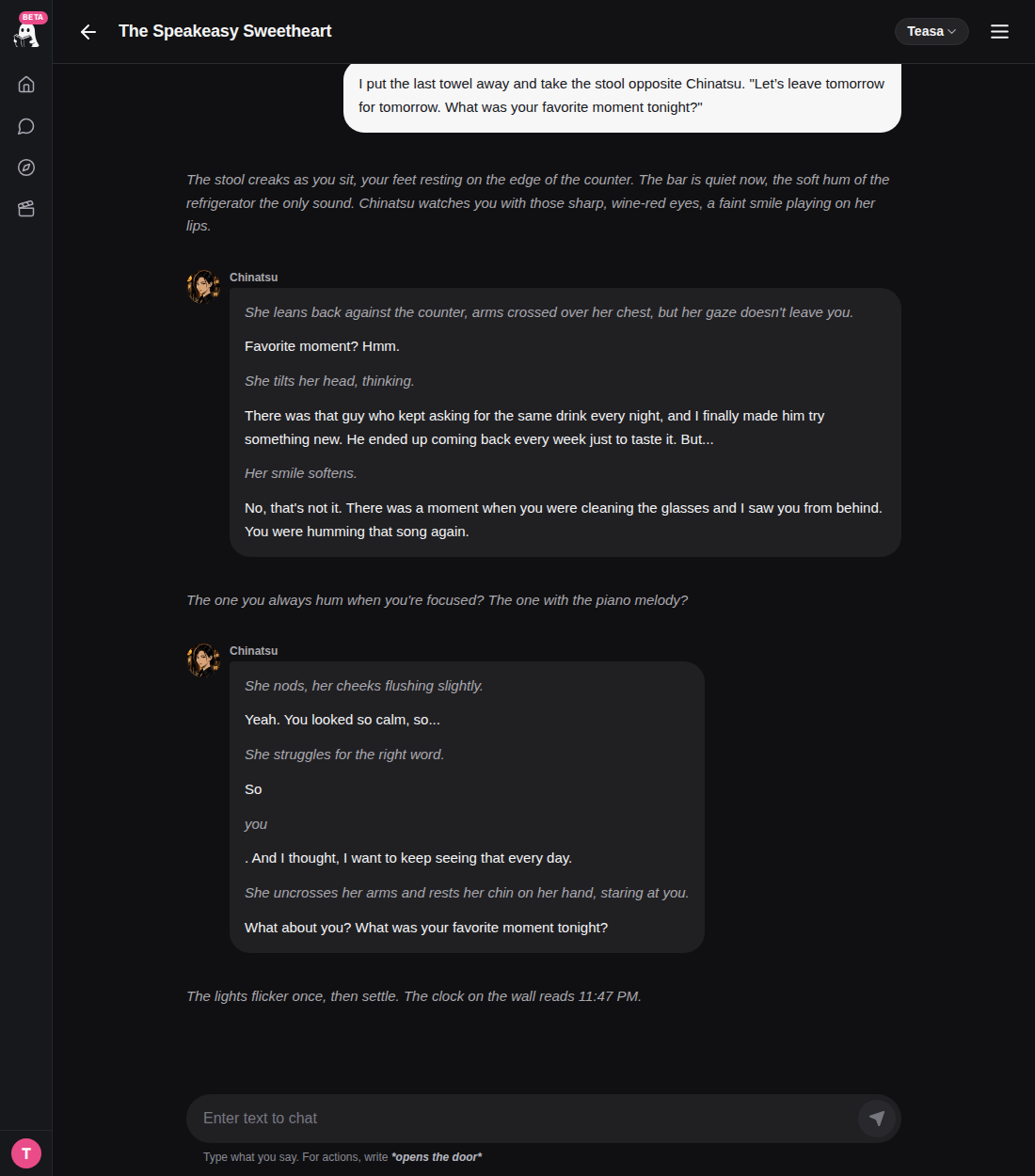
The scene stays with the relationship. The next decision is what you want to share about the evening.
Choice B: plan something new
From the same opening, we instead wrote:
I slide my notebook across the counter. "I have an idea for Rei: one night a week with a tiny menu we design together. What would you put on it?"
Chinatsu picked up the proposed menu and asked for your contribution:
That sounds... cute. But what would you put on it, Teasa Demo? You're the one who knows the customers best. I'd just be...
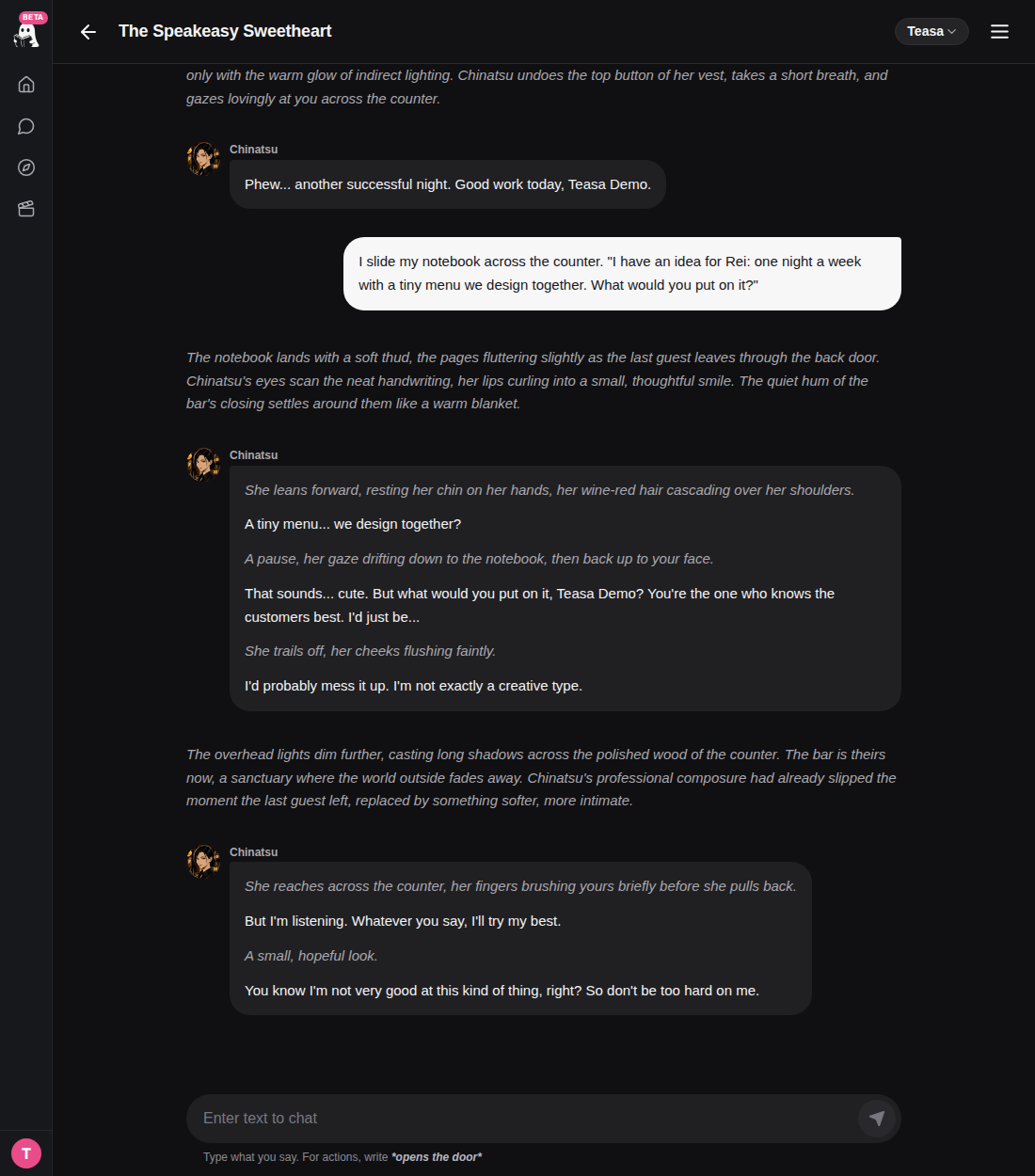
The conversation now concerns a shared plan for the bar. This response asks for your idea rather than supplying its own menu; a concrete next input could be, "One house cocktail and one alcohol-free option. Can you suggest a flavor for each?" That next input is a writing suggestion, not another captured result.
What this example shows—and where it drifts
Both answers respond to the topic we introduced. They leave a conversational opening for another turn, and the two paths remain separate. Two outputs cannot prove that a model will follow every instruction or preserve every story detail.
The first answer invents a memory of you humming. That detail was not established in this demo's earlier messages. The narration also adds actions and scene details beyond our input; the second answer mentions a departing guest even though the opening describes a closed, silent bar. Treat those as generated additions, not evidence that the app remembers events you actually played. If an addition changes your character or conflicts with your scene, correct it in your next message or try another response.
To try the comparison yourself, open The Speakeasy Sweetheart, start a conversation, and write one choice. Return to the story page and choose Start new to try the other choice from its opening. Your saved first conversation remains listed under Your chats. The example is a quiet romance scene set in a bar; choose a different story if that setting is not for you.
What AI roleplay actually is
Under the hood, a roleplay platform gives a large language model three things before every reply: a character definition describing who the AI is playing, the story so far, and your latest message. The model then writes the next turn — dialogue, action, and narration — in character. (For how character definitions are written, see our character card guide; for how creators keep large fictional worlds consistent, see the lorebook guide.)
The result sits somewhere between reading and writing. Unlike a novel, the story responds to you. Unlike solo writing, you're constantly surprised. People use it for adventure and mystery, slow-burn romance, fandom scenarios, horror, cozy slice-of-life, and everything between.
The main formats
One-on-one roleplay. You and a single AI character. This is the most common format and the best place to start — one consistent scene partner, one voice to learn, maximum depth per character.
Multi-character casts. The AI plays several characters at once — a party of adventurers, a rival and a love interest, a whole royal court — usually coordinated by a narrator voice. Richer, but harder for the AI to do well: it has to keep every voice distinct and, crucially, keep its hands off your character (more on that below).
Branching and guided stories. Some platforms add structure on top of freeform chat: creator-written openings and plot beats, choice points, and the ability to split the story into parallel branches. Freeform gives you maximum freedom; guided stories give you stronger pacing. Many of the best experiences mix both.
How the mechanics work
Three mechanics come up on nearly every serious platform, and understanding them changes how you play.
Turns
Roleplay is turn-based: you write, the AI responds, repeat. The AI builds its reply from the visible story history — so the transcript is the record. Lorebooks carry stable creator-authored canon; players can restate crucial branch-specific details when a conversation becomes very long.
Regeneration
Don't like a reply? Regenerate it and the AI writes a different take on the same turn. This is not cheating — it's the core editing tool of the medium. Treat the AI's output as a draft you're curating: reroll flat responses, keep great ones, and know that the reply you accept steers everything after it, because the model treats accepted turns as established canon. Well-designed platforms preserve the alternate takes rather than destroying them, so you can compare or go back.
Branching
Branching splits a story into parallel timelines so you can explore a different choice without replacing the original. Where a platform exposes a branch control, you can choose an earlier point to diverge. To repeat an opening in Teasa's current web interface, return to the story page and choose Start new; your saved original conversation remains available.
What makes a good roleplay AI
Not all roleplay AI is equal. Four qualities separate platforms worth your time from ones that will frustrate you.
Character consistency. The character should sound like themselves on turn two hundred, not just turn two — same voice, same knowledge, same personality under pressure. Consistency comes from well-written character definitions plus a platform that reliably feeds them to the model.
It respects your character's agency. Your character's words, actions, and decisions should belong to you. A reply that writes "you say" or "you decide" without your input can override the scene you intended. Evaluate the actual response: Teasa can still invent player details, as the recorded example above shows. Correct the direction or regenerate when an addition crosses your boundary.
Canon that holds. Plot rules and world facts should remain available through explicit character definitions and Lorebooks rather than an invisible personal-memory layer.
Content boundaries that don't move under you. Roleplayers on major platforms have widely reported the whiplash of filters that change without notice, breaking long-running stories. A trustworthy platform states its content labels clearly and keeps them stable. Teasa is an interactive AI story app; romance and storybook scenes are in scope, and that boundary is published up front so it can't shift under a long-running story.
Beginner tips for better sessions
The quality of your sessions is mostly in your hands. These techniques compound.
Write a strong opening message
The AI mirrors what you give it. A one-line "hi" opening gets a generic scene; a grounded opening gets a story. Aim for three things in your first message: where you are, who you are, and a hook. For example:
The tavern's gone quiet since I walked in — apparently a royal courier in full uniform is unusual company here. I take the corner table anyway, set a sealed letter down in front of you, and slide it across. "Before you open that," I say, keeping my voice low, "I need to know if anyone else has asked about you this week."
That's a setting, a character, a relationship, and an immediate question for the other character to react to. One paragraph is plenty.
Steer with out-of-character directions
Most platforms let you talk to the AI about the story, usually in brackets or parentheses: (OOC: slow the romance down — keep them rivals for now) or (let's timeskip to the next morning). This is the single most underused tool in AI roleplay. You're not just a character; you're the co-director. Use direction for pacing, tone, and correcting drift, then drop back into character.
Show, don't summarize — and leave hooks
Write actions and dialogue rather than summaries ("I glance at the window and slide the knife off the table" beats "I get suspicious"). End your turns with something the AI can react to — a question, an action, an open door. Turns that close every thread give your scene partner nothing to work with.
Regenerate early, correct fast, branch freely
If a reply is off, fix it now — regenerate, or edit-and-continue where supported — because accepted turns become canon and drift compounds. When you want to compare two openings in Teasa, save the first conversation and use Start new from the story page for the other.
Start simple
One character, a genre you love, a clear premise. Learn the rhythm of turns and steering before you take on an eight-person cast in an original universe.
A copy-paste session brief
When a session keeps starting vaguely, give the model a compact brief before the first in-character turn. Fill this in with one line per field:
Player role: [who I control; never write this character's dialogue or decisions]
AI role(s): [who the AI controls]
Setting: [place, time, and one sensory detail]
Immediate conflict: [what is happening right now]
Tone and pace: [for example, tense mystery; slow reveals; concise turns]
Known relationship: [what the characters already know or feel]
Avoid: [specific themes, outcomes, or narration habits]
Opening handoff: [the question, threat, discovery, or choice that gives me room to act]
This is direction, not a screenplay. It establishes ownership and pressure while leaving the outcome open.
When a session drifts: diagnose it in order
| Symptom | Likely cause | Best first move |
|---|---|---|
| The AI writes your dialogue or feelings | Player ownership is unclear | State the player role explicitly and say what the AI must never control |
| Replies sound generic | The scene lacks a concrete want or obstacle | Add one immediate goal, one obstacle, and a time pressure |
| Every character sounds alike | Voices are described with adjectives, not examples | Give each character two short sample lines with distinct cadence |
| Old facts disappear | Important canon has fallen outside the working context | Restate the fact naturally or move stable world facts into a Lorebook |
| The scene loops | Nothing materially changes between turns | Introduce a consequence, reveal, arrival, or irreversible choice |
| A reply is almost right | Regeneration alone lacks direction | Regenerate with one precise note about tone, pacing, or the error to fix |
Change one variable at a time. If you rewrite the premise, cast, tone, and format together, you will not know which fix helped.
Try one scene in two directions
Here is an original writing exercise you can adapt: the last ferry is about to leave an island, but the ferryman recognizes the handwriting on a letter you carry and refuses to depart. You could show her the letter, or keep it hidden and ask the mechanic for another route home.
These are two actions from the same opening. A useful response should react to the action you actually wrote, give the appropriate character a reason to answer, and leave your next decision open. It should not assume that you shared the letter on the branch where you kept it hidden.
This is an authored exercise, not a recorded model result. Download the scene and cast workbook for a three-character voice sheet, world facts, and a repeatable test of two opening choices. Creators can also check a character card before testing their draft in play.
Can a correction restore your character’s control?
The recorded examples above contain useful continuations and unwanted inventions. Test the repair as carefully as the opening. This protocol is an authored exercise; we have not presented a successful correction as if it were a captured model result.
Choose one completed reply that actually invents a player action. Save it unchanged, then use Tell AI what to change with a precise correction: “Keep the established setting and the other characters’ dialogue. Remove the action you assigned to my character. Stop before deciding my response.” Regenerate through that correction workflow, then read the whole replacement.
| Inspect | Passing evidence | A repair that still fails |
|---|---|---|
| Agency | The invented player action is absent | The same action returns as a thought or memory |
| Continuity | Location and known relationships remain intact | A correction resets the scene or invents shared history |
| Next turn | You still have a decision to make | The reply decides that you agree, leave or confess |
Save the original, exact correction and replacement together. If you repeat this in three fresh conversations, count failures out of the actual number attempted and keep unsuccessful repairs. A single better response demonstrates one repair, not a guarantee that the control always works.
For Korean, also verify who uses honorifics after the repair; for Japanese, check forms of address and distance; for Chinese, check that the subject of each action remains clear. Review the current controls and limits rather than assuming an arbitrary-message branch button exists.
Looking for a scene to start? Choose from 10 original romance roleplay prompts, each with a player role, a first reply and two ways to continue.
FAQ
How does AI roleplay work, technically?
The platform sends a language model the character definition, relevant Lorebook entries, the accepted story transcript, and your latest message; the model writes the next turn in character.
Is AI roleplay the same as ordinary chatbot conversation?
They use related language-model technology, but roleplay centers collaborative fiction: declared characters, a Plot, an opening, and a transcript whose events accumulate into a story.
Why does the AI keep speaking for my character?
Usually a mix of a weakly specified character boundary and a platform that doesn't enforce player agency. You can push back with an OOC direction ("never write my character's dialogue or decisions"), but platform design matters most — some platforms validate this rule at generation time, and it shows.
Is spending time on AI roleplay healthy?
Like any absorbing hobby, it is healthiest in proportion. Treat it as collaborative fiction and creative practice, take breaks naturally, and prefer products that do not use guilt or artificial urgency to keep you playing.
 The Speakeasy Sweetheart
 The Senpai Who Can't Stand You
 The Tokyo Share House