 teasa.ai
In this guide
See a real session take two directions
In The Speakeasy Sweetheart, the bar has closed and Chinatsu thanks you for the evening's work. You are her partner and a junior member of the bar staff. We tried two inputs from that same opening:
- Wind down together: ask what her favorite moment was. The response turns toward a personal recollection and asks about yours.
- Plan something new: propose a small menu for the bar. The response discusses the idea and asks what you would contribute.
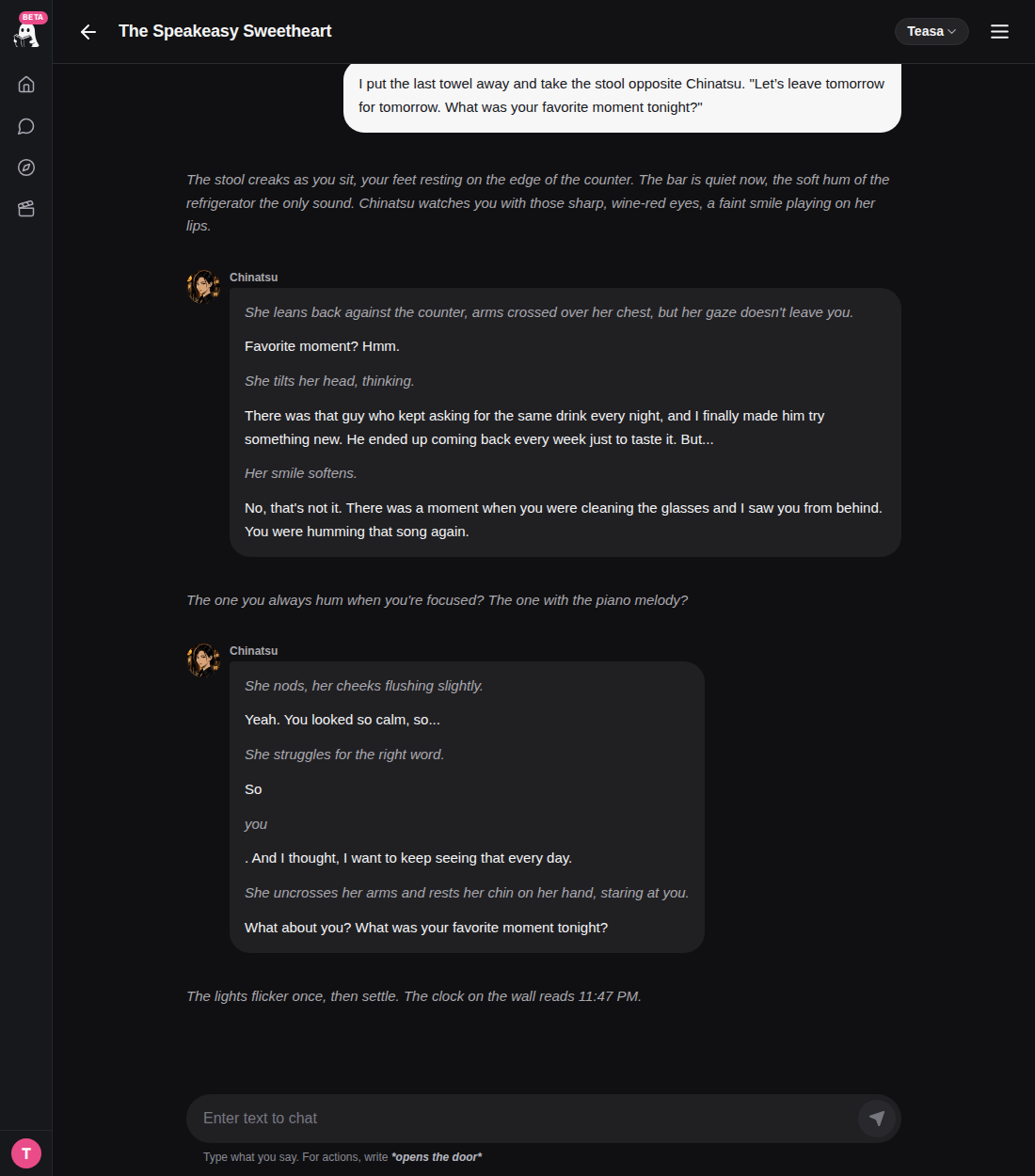
Recorded in English on 9 September 2026 using Teasa, with the first response to each input and no response edits or regenerations. These are examples, not fixed outcomes. The model also invented details, including a shared memory that was not established in the demo.
Read both inputs, responses, and what we learned, or play the story yourself.
More than a chatbot with a character picture
A character chatbot begins with a persona and a conversation. An interactive AI story needs more structure:
- A premise with real stakes. You should know where you are, what is changing, and why your next action matters.
- An authored opening. The first scene gives the player something concrete to respond to.
- A cast, not one interchangeable voice. Each character has a role, history, speech style, relationships, and private motivations.
- A player role. The creator establishes what the world knows about your place in it without deciding your feelings or choices.
- A Lorebook. Places, factions, objects, and history enter the model when the scene needs them.
- Story style. Point of view, tense, pace, difficulty, and narrative direction stay consistent with the Story.
- A durable transcript. The conversation records what actually happened in this version of the story.
Teasa packages those pieces as a Story: a publishable interactive story that another person can discover and play.
Your words are the choices
Choice-driven story games are powerful because writers can design every route. Their limit is equally clear: if the action you want is not in the menu, it does not exist.
In Teasa, the text box is the choice system. Bargain with an enemy instead of fighting. Ignore the obvious love interest. Ask the quiet member of the cast what they noticed. Walk out of a scene and force the story to follow. The next turn is generated from the Story, relevant Lorebook entries, and the transcript you have created.
That freedom is why interactive AI story is a better description than “chatbot,” and why Teasa is not quite a conventional visual novel. The AI visual novel vs. AI roleplay guide explains the difference.
Multi-character stories without losing your character
Ensemble scenes are one of the hardest tests for roleplay AI. The system has to keep several voices distinct, track who is present, and move the scene forward without writing the player's side of the exchange.
The intended division is clear: the AI speaks as members of the cast and narrates the environment, while you decide your character's dialogue and actions. Models can still overstep that boundary or confuse a detail. A clear player role helps; correction, another response, and a fresh conversation give you ways to steer the session when it drifts.
This produces a simple creative contract:
The creator defines the world. The AI plays the world. You play your character.
To see how Teasa, DreamGen, SillyTavern, Character.AI and other apps put several characters in one scene, read the multi-character AI roleplay guide.
Try a different direction
Sometimes a reply misses the tone you wanted. Sometimes you want to try a different first choice while keeping the conversation you already played.
In the web app:
- Regenerate requests another answer to a message.
- Tell AI what to change lets you give a direction such as "slow down" or "keep the secret" before generating another response.
- Start new, on the story page, begins a separate conversation from the opening. Saved conversations remain available under Your chats.
For the comparison above, try one input, then return to the story page and start a new conversation for the other. A different response is an opportunity to explore; it is not a guarantee that every detail will improve.
Lorebooks keep larger worlds coherent
An entire fictional world cannot sit in the model's permanent instructions. Irrelevant information consumes the same context budget needed for the recent scene.
Lorebooks solve that problem by loading world information when it becomes relevant. Mention a city, faction, artifact, or historical event and its entry can enter context. A small number of invariant rules can remain always on.
Creators can begin with What Is a Lorebook?, which includes entry structure, trigger examples, and common mistakes.
Built for players and creators
Players can browse Stories by genre, mood, cast, pace, content level, and warnings. Public Plot pages show the premise, opening, creator, and safe public details before a story begins.
Creators can keep drafts private, separate public descriptions from private direction, test a Story before publishing, and release immutable versions. Remixing carries public structure and attribution; it does not copy private character definitions or Lorebook bodies.
If you are designing your first cast member, use the AI character-card template and examples. If you want to understand turns, regeneration, and branching first, read the AI roleplay guide.
An AI story generator you play from the inside
Most AI story generators write a whole story from a prompt and hand it back. Teasa generates the story one turn at a time around what you write: you are a character in the scene, the cast answers your words, and the plot bends toward your choices. You get the surprise of a story generator with the agency of a game, and every Story starts from a creator's opening, so there is always something happening on the first screen.
- Start from a premise, not a blank box. Every Story has an opening scene, a role for you and a cast with something at stake.
- Steer with dialogue and actions. Type what you say or do; regenerate a reply or branch the conversation to try another direction.
- Keep what you made. Your chats are saved, so a story you like is there when you come back.
Play in your browser, no download
Teasa runs in any browser at teasa.ai as well as on Android, and you can play your first turns as a guest before creating a free account. Rather jump straight into a conversation? Free AI chat online opens a chat with a Character in one tap. If you came looking for a way to play a phone-first app on a computer, see Talkie online free on PC and now.gg, AI chat with no sign-up and Perchance AI chat and what to try next.
Is there a free interactive story AI?
Yes. Teasa is free to play: every Story is free to start, and direct messages with any Character are free and unlimited, with ads shown to free accounts. The Hojicha chat style is always free, and Matcha, Teasa's other chat style, is free for now too. Creator Studio is also free, so building and publishing your own Story or Character costs nothing. The free AI chat online guide sets everything free beside Teasa Pass.
Teasa Pass is the optional paid upgrade, at $14.99 a month: it removes ads, adds the Oolong chat style, lets eligible Characters look up real-world information with sources, and includes 200 Gems a month for scene images and other premium media. None of that is required to play — see current prices and what each plan includes.
A story is where you meet. The connection keeps going.
An interactive AI story gives you a world to explore, a role to play and people to meet. An AI companion gives you someone to talk to beyond a single scene. Teasa brings those experiences together.
Pursue creator-authored quests and earn relationship milestones through shared moments. Open History to watch your bond grow from Just met to Inseparable. Message any Character directly about their world or your day, and when you agree on a date, Teasa turns it into a private Story for the two of you. With Teasa Pass, direct chats can look up real-world information and show sources.
Your Memory panel puts saved facts and relationship achievements in view, with controls to review and forget facts. Learn about memory, bond progress and direct chat.
Start with a Story
The fastest way to understand the format is to play one complete scene. Pick a premise that makes your role clear, write the response the creator could not have predicted, and watch how the cast adapts.
Discover interactive AI stories on Teasa, or see how the format compares with Zeta AI and Character.AI.
What to try in your first scene
Choose a story whose opening makes your role clear. Write one line of dialogue or one action, read how the cast responds, and choose your next move. If you want to understand the format first, our roleplay guide walks through a scene in two directions. The recommendations below come from the current published catalog.
FAQ
What is an interactive story AI?
It is a story generated turn by turn from an authored premise, characters, world information, conversation history, and the player's free-form input. Unlike a fixed choice game, the player can write an action the creator did not anticipate. Teasa is an interactive story AI built around Stories with a staged opening, a cast and a role for you.
Is there a free interactive story AI?
Yes. Every Teasa Story is free to play, direct messages with any Character are free and unlimited, and Creator Studio is free to build and publish in. Teasa Pass is an optional $14.99-a-month upgrade for the Oolong chat style, web lookup and no ads; see pricing for the full plan details.
Is Teasa an interactive AI story generator?
Teasa generates the next turn of an interactive story during play, in an interactive AI story game shaped by what you type rather than a menu of choices, and provides tools for creators to build publishable Stories. It is not a one-click tool for generating and exporting a finished novel.
Can an interactive AI story have multiple characters?
Yes. Teasa Stories can use an ensemble cast with separate character profiles, voices, relationships, secrets, and opening-presence controls.
Does the AI control my character?
You supply your character's words and choices; the AI is intended to play the cast and setting. Replies can still invent actions, feelings, or history you did not provide. Review the response and correct or regenerate it when that happens. The recorded example above shows why this distinction matters.
Can I create my own story?
Yes. A creator can define the premise, opening, cast, player role, Lorebooks, style, content level, warnings, and private direction, then test and publish the Story.
 The Speakeasy Sweetheart
 The Senpai Who Can't Stand You
 The Tokyo Share House
 Reunion at the Host Club
 The Boss's Demand
 The Cold Neighbor Who Wants Only You