 teasa.ai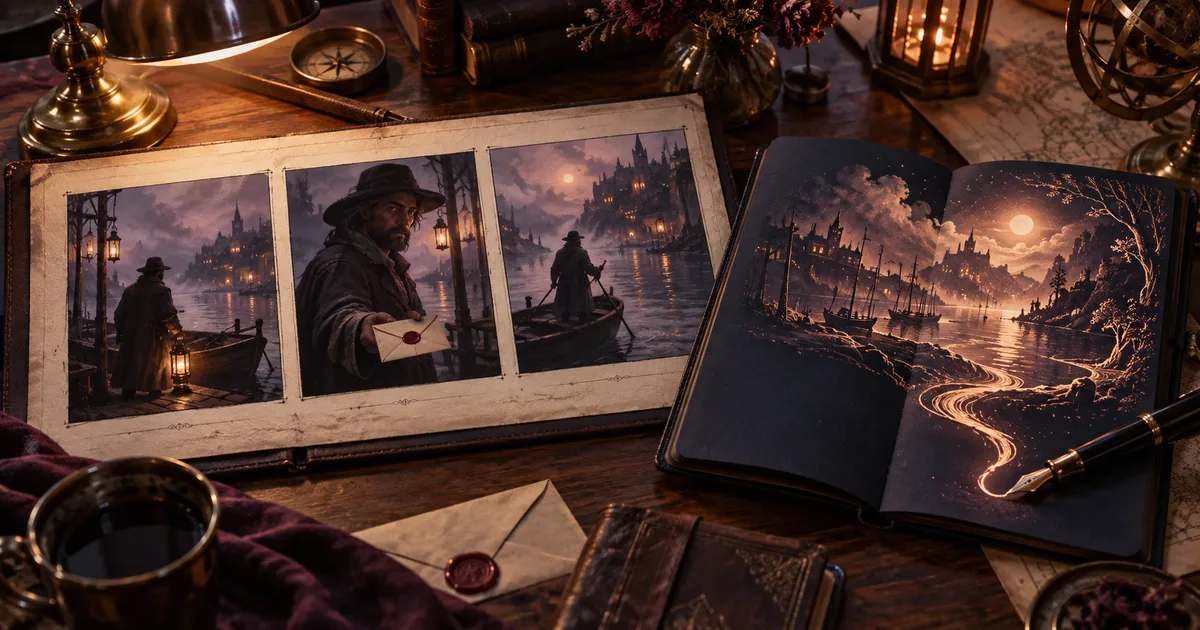
In this guide
The last ferry is about to leave. The ferryman recognizes the handwriting on your sealed letter and refuses to cast off. Do you reveal the letter, hide it, or invent another way aboard? That small scene makes the difference between authored choices and free-form AI roleplay easier to feel.
A traditional visual novel usually offers paths the writer prepared. In free-form AI roleplay, you write an action and the system generates a continuation. Products described as "AI visual novels" may mix these approaches, so the label alone does not tell you what you can do — and the same question comes up again one layer down, in genres like the AI otome game and the AI dating sim, where "choose a route" and "write anything" are marketed almost interchangeably.
One scene, two ways to participate
The scene below is an authored writing exercise. Its choices and possible consequences were written for this guide; they are not screenshots or recorded model responses.
01 / Authored choices
Choose a prepared route
- Show the letter. The ferryman names its sender.
- Hide it. He demands another reason to let you aboard.
- Walk away. The scene follows you back to the harbor.
These are three possible routes a writer could prepare and test.
02 / Free-form input
Write a fourth move
I ask the mechanic to keep the ferryman talking while I inspect the seal without opening the letter.
Now the continuation has to interpret an action outside the prepared menu.
The distinction is what happens after the input. The authored version can deliver a carefully revised consequence. The generated version can respond to an unexpected plan, but may misunderstand it or add something you never intended.
Follow the fourth choice for one more turn
Suppose you write: "I ask the mechanic to keep the ferryman talking while I inspect the seal without opening the letter."
A useful continuation needs to preserve three facts: the letter is still sealed, you asked the mechanic for help, and the ferryman has not yet agreed to leave. It can create pressure by having him notice the delay. It should leave you room to decide whether to explain, conceal, or abandon the plan.
A reply that announces "you read the letter and confess everything" may sound dramatic, but it has skipped your action and decided your next move. That is the trade-off to evaluate in an actual AI roleplay story: more possible inputs do not automatically mean more control over the result.
For genuine recorded output, our roleplay walkthrough compares two inputs in the same live story, including the details the model got wrong.
What people searching for an AI visual novel, otome game or dating sim actually want
The three searches overlap but aren't identical. "AI visual novel" and "generative visual novel" usually mean wanting the visual, scene-by-scene presentation of a classic visual novel with AI writing or generating some of the content. An otome game is a specific lineage inside that format: a story-based romance game where the player experiences the story as a female-perspective lead and works toward a relationship with one of several male love interests, a structure dating back to Koei's 1994 Angelique. An AI dating sim borrows the dating sim's statistical layer — affection points, a schedule, multiple romanceable characters and multiple endings — but replaces at least some of the fixed dialogue trees with generated text.
What people actually want when they type any of these terms is usually one of two things: character art, music and a designed relationship arc with a satisfying ending, or a conversation partner who reacts to whatever they actually type instead of a fixed menu. Very few products deliver both at full strength, which is why comparing visual novel vs AI roleplay on a specific scene, rather than trusting a label, tells you more than the app-store description does.
What changes for the reader?
| What you care about | Authored visual novel | Free-form AI roleplay |
|---|---|---|
| Choosing an action | Select from what the scene supports | Write your own dialogue or action |
| A mystery with a precise reveal | The writer can place and revise every clue | The AI may reveal, forget, or invent a clue |
| Relationship pacing | Follow a designed route and its available choices | Ask for a slower pace or another direction; check the response |
| Visual presentation | Often includes backgrounds, sprites and scene transitions | Varies by app; portraits do not imply illustrated scenes |
| Replaying | Discover another prepared route | Try new inputs and receive variable continuations |
| Editing during play | Usually limited to the game's controls | Corrections and regeneration may be part of the experience |
This describes two common approaches, not a rule for every game. The Ren'Py quickstart shows a concrete authored workflow using dialogue, character images, menu choices and branching script.
Pick the experience you want tonight
- "I want a mystery whose clues pay off." Start with an authored story if deliberate setup and resolution matter most.
- "I want to negotiate with someone the story expects me to fight." Free-form roleplay gives you a place to write that attempt.
- "I want expressive character art and scene direction," an AI otome game feel. Check actual gameplay footage or screenshots. A beautiful cover cannot establish what happens inside the story.
- "I want to write at my own pace and adjust the relationship," an AI dating sim without the fixed script. Try roleplay, while expecting that some replies will need correction.
You can enjoy both formats for different reasons. A curated route can be satisfying precisely because somebody shaped it; an improvised scene can be satisfying because neither participant knew the next turn.
What the creator must prepare
For the ferry scene, an authored route needs the supported choices, consequences, state changes, and any visual assets. A free-form version needs a clear opening, distinct character motives, reliable world facts, and tests for actions the creator did not anticipate.
Give the ferryman a reason to withhold passage, the mechanic a practical priority, and the player an unresolved question. Use a character card for each person's voice and motive. Put the harbor's travel rules in a Lorebook, keeping this conversation's decisions in its transcript.
Where Teasa fits, and how Stories, quests and milestones work
Teasa's play experience is primarily a text conversation: creator-built Stories provide the setting, opening and cast, and you supply your character's input, the free-form side of this comparison rather than the authored-route side. It does not promise a traditional visual-novel presentation or an illustration for every generated scene.
A Story can carry quests, so you're working toward a visible objective with progress kept in History, and relationship milestones, so the moments you earn with a Character are tracked rather than left to memory. Outside the Story, you can message any Character directly, about what just happened or about something else entirely. Those direct chats are free and unlimited; Teasa Pass adds the Oolong chat style and lets eligible Characters look up real-world information and show their sources. A Memory panel lists what's been saved about you and lets you forget any of it. Creator Studio is where you build the cast and world behind all of it: reusable Characters, Blueprints for setting and lore, and private play-tests before you publish.
Where to start
- Romance stories — the closest genre match to what an AI otome game or AI dating sim searcher usually wants.
- Isekai & Reincarnation stories — a full world established from the opening line, a common otome and dating-sim setup.
- CEO & Billionaire Romance stories — a familiar dating-sim archetype, played as free-form roleplay instead of a fixed route.
- Slow Burn Romance stories — relationship pacing you steer turn by turn, rather than a designed route.
- Fantasy stories — for readers who want the ferry scene's stakes without a specific romance focus.
How to compare two openings in the current web app
- Choose a story with a clear player role and write your first action.
- Read the completed response. Note whether it followed your action and which facts it added.
- Return to the story page and select Start new for the second input. The original remains under Your chats.
- Use the response menu to regenerate or tell the AI what to change if a reply drifts.
A fresh conversation compares openings; it is different from changing one reply. The current interface does not offer an arbitrary-message branch button.
FAQ
Is an AI visual novel always free-form?
No. AI may be used to create art or dialogue while the player still chooses from a fixed menu. Check the actual input and how much it can change the scene before assuming "AI visual novel" means free-form.
What is an AI otome game?
An otome game is a romance game built around a female-perspective lead choosing between several love interests; an AI otome game lets you write your own lines instead of picking from pre-written replies. The AI otome game and dating sim guide explains the classic loop and picks Teasa Stories that play like routes.
Is Teasa an AI dating sim or AI otome game?
Teasa has no dating-sim affection meter or schedule, and no fixed love-interest routes. Its romance Stories play like an AI otome game where you write every line: creator-built Stories with an opening and cast, and quests and relationship milestones that track progress instead of a stat meter. The AI otome game guide compares it with Episode, Choices and Romance Club.
Is Teasa a traditional visual novel?
No. Its story runtime is primarily a generated text conversation, with creator-defined characters and openings. It does not provide a fully scripted route with scene-specific art for every possible turn.
What's the real difference between visual novel vs AI roleplay?
An authored visual novel routes you through choices the writer prepared and tested in advance, with a precise, revisable ending. AI roleplay generates a continuation from whatever you actually type, so it can respond to more situations but can also misread one. Comparing the same scene both ways, as this guide does, shows the trade-off directly.
Which format has better stories?
Neither format guarantees quality. For an authored route, evaluate writing, pacing and payoff. For roleplay, also evaluate how accurately replies follow your input, preserve facts and leave your character's decisions to you.
Can I play an AI otome game or AI dating sim style story for free?
You can start playing Teasa Stories, including romance-focused ones with the pacing and stakes an otome game or dating sim searcher usually wants, for free. Direct Character chats are free and unlimited for every signed-in account; Teasa Pass adds the Oolong chat style and live web lookup with sources.
Can I try the ferry example in this guide?
It is a writing exercise, not a published playable Plot. You can use it as a starting point for your own draft, or choose an existing story from Teasa's catalog.
 The Speakeasy Sweetheart
 The Senpai Who Can't Stand You
 The Tokyo Share House
 Reunion at the Host Club